The Most Overlooked Upgrade in GTA V Graphics Might Be Happening Above Your Head

U1D Team
May 29, 2026 · 7 min read
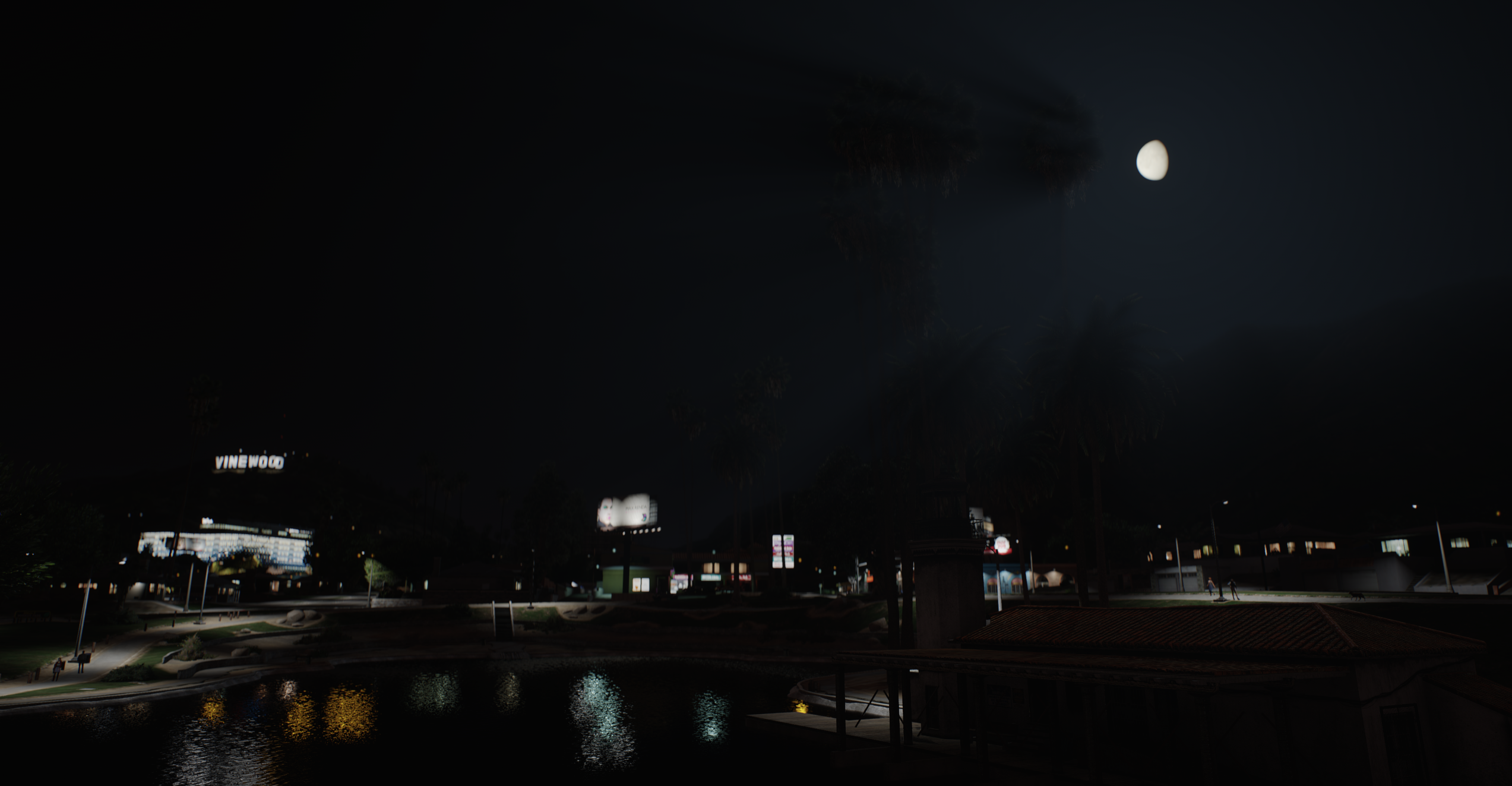
When players think about graphics mods for Grand Theft Auto V, they usually focus on the obvious improvements.
Things like:
- Vehicle reflections
- Better shadows
- Realistic weather
- Improved vegetation
- High-resolution textures
- Enhanced lighting
These features have traditionally dominated graphics discussions throughout the GTA V community.
But recently, attention has started shifting toward something entirely different.
The sky itself.
More specifically, how environmental lighting interacts with the atmosphere during nighttime hours.
As graphics projects continue pushing the limits of Rockstar's engine, developers are discovering that some of the most dramatic visual improvements come not from the ground beneath the player, but from the light sources above them.
This growing focus on atmospheric moonlight and volumetric lighting is helping redefine what nighttime can look like in GTA V.
The Night Sky Has Always Been an Untapped Asset
Los Santos is famous for its sunsets.
Countless screenshots, videos, and graphics showcases highlight the game's daytime beauty.
However, the night sky often receives far less attention.
In reality, nighttime environments present some of the greatest opportunities for visual immersion.
Without the overwhelming brightness of the sun, subtle atmospheric effects become much more noticeable.
Players begin to pay attention to:
- Cloud movement
- Fog density
- Light scattering
- Moonlight intensity
- Environmental contrast
These details may seem small individually, but together they determine how believable a nighttime scene feels.
Why Modern Graphics Are Moving Beyond Surface-Level Improvements
For years, graphics modifications focused primarily on improving objects.
Developers enhanced:
- Roads
- Buildings
- Vehicles
- Water
- Vegetation
The industry is now moving toward a different philosophy.
Instead of focusing only on objects, modern graphics development focuses on environments.
The question is no longer:
"How realistic does this object look?"
The question has become:
"How realistic does this world feel?"
Atmospheric systems play a massive role in answering that question.
This is why features such as volumetric moon rays are generating so much attention among graphics enthusiasts.
Understanding Atmospheric Presence
One of the hardest concepts to explain in graphics development is atmosphere.
Players know when atmosphere feels right.
They also know when something feels off.
Atmosphere is what makes a location feel:
- Cold
- Warm
- Dangerous
- Peaceful
- Mysterious
- Immersive
It is the invisible layer connecting every visual element on screen.
Lighting contributes heavily to that feeling.
When moonlight interacts naturally with clouds, fog, and environmental haze, the atmosphere becomes far more convincing.
Instead of feeling like a collection of assets, the world begins to feel interconnected.
Why Moonlight Creates a Different Kind of Realism
Sunlight dominates daytime scenes.
Its brightness naturally draws attention.
Moonlight works differently.
It relies on subtlety.
A realistic moonlit environment doesn't overwhelm the player.
Instead, it creates mood.
This is why moonlight can often have a stronger emotional impact than daylight.
Players notice:
- Silhouettes
- Shadows
- Environmental depth
- Contrast
- Distance visibility
These visual elements help create a more cinematic experience.
Advanced moonlight rendering amplifies these effects significantly.
The Emergence of Volumetric Moon Rays
One of the most significant developments in GTA V nighttime graphics is the implementation of volumetric moon rays.
This technology allows moonlight to interact with atmospheric conditions in a much more realistic way.
Rather than simply illuminating objects, the light becomes visible as it travels through the environment.
The effect can be seen interacting with:
- Fog banks
- Cloud cover
- Dust particles
- Atmospheric moisture
- Environmental haze
The result is a more believable nighttime atmosphere that feels closer to modern game engines.
Why Weather Conditions Suddenly Matter More
Volumetric lighting becomes especially noticeable during certain weather conditions.
Clear nights may showcase subtle improvements.
Foggy nights often reveal the full potential of the system.
Weather events such as:
- Misty mornings
- Coastal fog
- Light rain
- Heavy overcast conditions
allow moonlight to interact directly with the atmosphere.
This creates scenes that feel dynamic rather than static.
The environment appears to react naturally to changing conditions.
For many players, this represents one of the most realistic visual upgrades available today.
Los Santos After Midnight
The city itself benefits greatly from improved atmospheric lighting.
At night, Los Santos becomes a mixture of:
- Artificial illumination
- Vehicle headlights
- Building lights
- Street lamps
- Moonlight
Balancing these various light sources is incredibly difficult.
When done correctly, the city feels more alive.
The skyline gains additional depth.
Roadways become more immersive.
The transition between urban and rural environments feels smoother.
Volumetric moon rays contribute to this balance by helping natural light coexist more realistically alongside artificial lighting systems.
The Forgotten Beauty of Blaine County
While urban environments often dominate screenshots, rural areas frequently showcase atmospheric lighting at its best.
Locations throughout Blaine County provide ideal conditions for volumetric effects.
These include:
- Mount Gordo
- Mount Chiliad
- Paleto Forest
- Senora Desert
- Cassidy Creek
- Raton Canyon
With fewer competing light sources, moonlight becomes the primary visual feature.
Players exploring these regions often notice dramatic improvements in environmental depth and realism.
The landscape feels larger.
The atmosphere feels denser.
The world feels more alive.
Why Story Mode Players Benefit the Most
Many discussions surrounding graphics modifications focus on content creators and screenshot enthusiasts.
However, story mode players may actually experience the greatest benefit.
Single-player gameplay naturally encourages slower exploration.
Players spend more time:
- Driving through the countryside
- Exploring remote locations
- Experiencing weather changes
- Watching day-night transitions
Atmospheric enhancements become far more noticeable during these moments.
Rather than rushing between objectives, players have opportunities to appreciate the environmental improvements surrounding them.
A New Direction for Graphics Development
Recent updates from several leading graphics projects suggest that environmental realism is becoming a major priority.
Developers are increasingly focusing on systems that improve:
- Atmospheric depth
- Environmental lighting
- Fog interaction
- Volumetric effects
- Dynamic weather immersion
One of the most notable recent additions comes from a popular remastered graphics project that recently introduced volumetric moon rays as part of its ongoing effort to modernize GTA V's nighttime environments.
The update highlights a growing industry trend toward creating more realistic atmospheric experiences rather than relying solely on traditional graphics enhancements.
Why Search Interest Around Night Graphics Keeps Growing
Search trends show increasing interest in advanced nighttime rendering.
Popular searches include:
- GTA V Volumetric Moon Rays
- GTA V Moonlight Graphics
- GTA V Atmospheric Lighting
- GTA V Realistic Night Graphics
- GTA V Night Sky Overhaul
- GTA V Volumetric Effects
- GTA V Story Mode Graphics
- GTA V Realistic Lighting Mod
- GTA V Cinematic Graphics
- GTA V Next Generation Graphics
This growing demand reflects a broader change in how players evaluate graphics projects.
Visual quality is no longer judged only by sharpness or reflections.
Players want atmosphere.
They want immersion.
They want environments that feel believable.
The Future May Belong to Atmospheric Graphics
Graphics technology continues evolving at an incredible pace.
Yet some of the most impactful improvements are not necessarily the most obvious.
Atmospheric systems operate quietly in the background.
They shape mood.
They influence immersion.
They create memorable moments without drawing attention to themselves.
Volumetric moon rays represent exactly this type of advancement.
They do not reinvent GTA V.
Instead, they enhance the experience in ways that feel natural.
As developers continue refining atmospheric rendering systems, features like advanced moonlight interaction, environmental light scattering, and volumetric effects are likely to become increasingly important within the world of GTA V graphics.
For players seeking the most immersive version of Los Santos possible, the sky may have become the most exciting place to look.